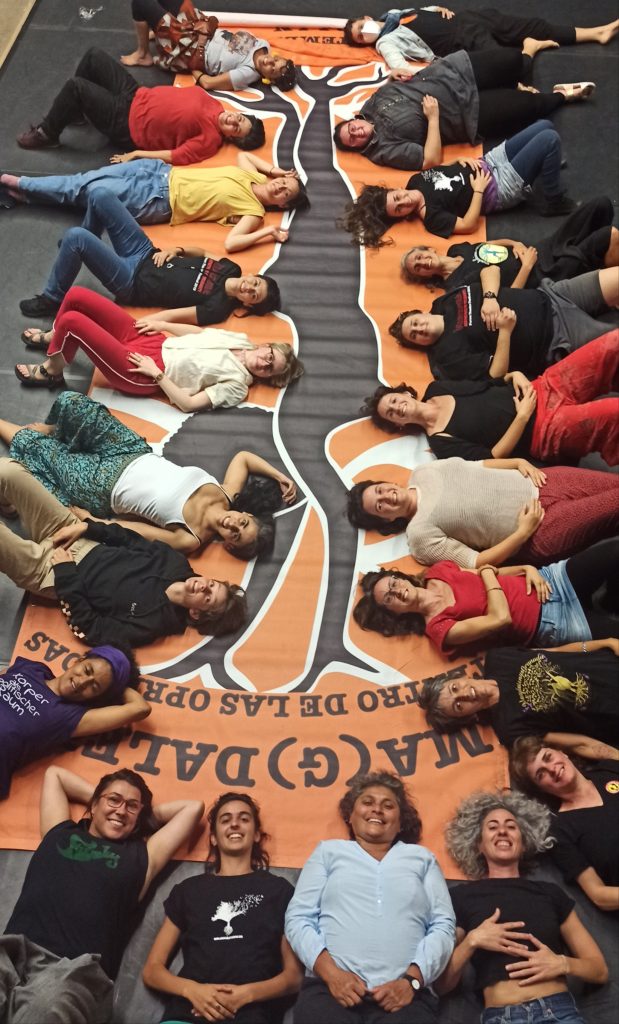
Join us on October 19th at 7:00 PM for a special event in celebration of the Teatro de las Oprimidas with the feminist theatre group Madalena-Berlinand their last productio “Integration-DES-integration”
“Integration-DES-integration“ explores the complex themes of belonging, identity, and social integration. Through a rich and dynamic blend of sounds and rhythms, the play examines how cultural differences can lead to conflict, yet also create opportunities for growth and enrichment. What does it truly mean to integrate into a society? Is it merely about legal documents and employment, or is it about forging deeper connections and a sense of belonging?
Under the creative direction of Bárbara Santos, Madalena-Berlin utilizes Forum Theatre, an interactive form of theatre that invites the audience to engage directly with the performance. Viewers are encouraged to reflect on the issues presented and actively participate in transforming the on-stage situations, seeking collective strategies to overcome social challenges, particularly those related to identity, gender, and social justice.
This event offers a unique opportunity to engage with urgent social issues through the transformative power of theatre. Madalena-Berlin is part of the Ma(g)dalena International Network, a collective of feminist theatre groups from Latin America, Europe, Africa, and Asia, all committed to overcome patriarchal oppressions .
Event details:
Date: October 19th
Time: 7:00 PM
Location: Kuringa (Grüntaler Straße 35 , 13359 – Wedding)
Unfortunately, Rio de Janeiro has gained national and international notoriety due to the unscrupulous actions of audacious criminals, who use various forms of knowledge, technologies, and beliefs in the service of organized crime. Beyond the explicit violence that spreads fear and allows territorial control, the illegal access to personal and banking data, manipulation of information, and the dissemination of lies enable a series of frauds against citizens. The collaboration between criminals and public officials, as was made evident in the murder of Marielle Franco and Anderson Gomes, ensures impunity, hinders investigations, challenges justice, and now also threatens democracy.
Since 2016, during electoral campaign periods, a vile attack on democracy has been taking place in Rio de Janeiro: a criminal group spreads lies about candidates through the staging of false situations at bus stops and crowded places, aiming to manipulate electoral outcomes. These groups arrive at predetermined locations and, in an unassuming manner, start spouting absurdities about the individuals they wish to defame. This way, they plant the seed of lies, later spreading them until a concrete doubt is established, which eventually takes on the appearance of “truth” through repetition. Only after eight years of this criminal activity, in the 2024 electoral campaign, have we become aware of yet another assault on democracy.
This group of criminals manipulates by labeling their criminal activity as invisible theater. The Federal Police makes a mistake by adopting the label given by the offenders as the official title of their investigation. “The investigations revealed that the criminal organization, through its leaders—who have even held public office in various cities of RJ—developed a sophisticated and profitable scheme based on hiring individuals with the goal of influencing the electoral process in several municipalities,” stated the Federal Police.
In reality, Invisible Theater has no connection to fraud or deceit. It is one of the techniques of the Theater of the Oppressed, a method systematized by playwright Augusto Boal (1931-2009). Created in Brazil in the 1970s, this method is now practiced in various languages and in different social, economic, and cultural contexts, from Canada to Argentina’s Patagonia, from South Africa to Denmark, from Greece to Australia, in more than a hundred countries across five continents.
The goal of Invisible Theater is to bring a topic into public discussion through an open question, never arriving with a definitive truth or answer. On the contrary, the idea is to create an environment where different perspectives can be introduced and debated horizontally, without establishing an absolute truth. The aim is to give visibility to issues that need to be discussed by society. Invisible Theater, like other techniques of the Theater of the Oppressed, focuses on creating environments for dialogue, encouraging the exchange of ideas, and fostering moments of collective reflection.
Augusto Boal often said that we, as human beings, have the best and worst within us, and we need to be educated, stimulated, and encouraged to develop our best. For this reason, he was an artist who put his art in the service of citizenship. We cannot allow criminals to distort the meaning of this art. Deceiving people to influence an electoral outcome is not theater. It is a crime.
What’s happening in Rio today is a complete misrepresentation of Boal’s work. Invisible Theatre was never meant to deceive or manipulate. Criminals are hijacking the name of this technique to create doubt and confusion, and we must resist and fight for its true meaning.
If you want to learn more about the true purpose of Invisible Theatre, we invite you to join our upcoming workshop in March 26th to 29th facilitated by Till Baumann for German speakers.
Exploring Media Legislation Through Feminist Legislative Theatre
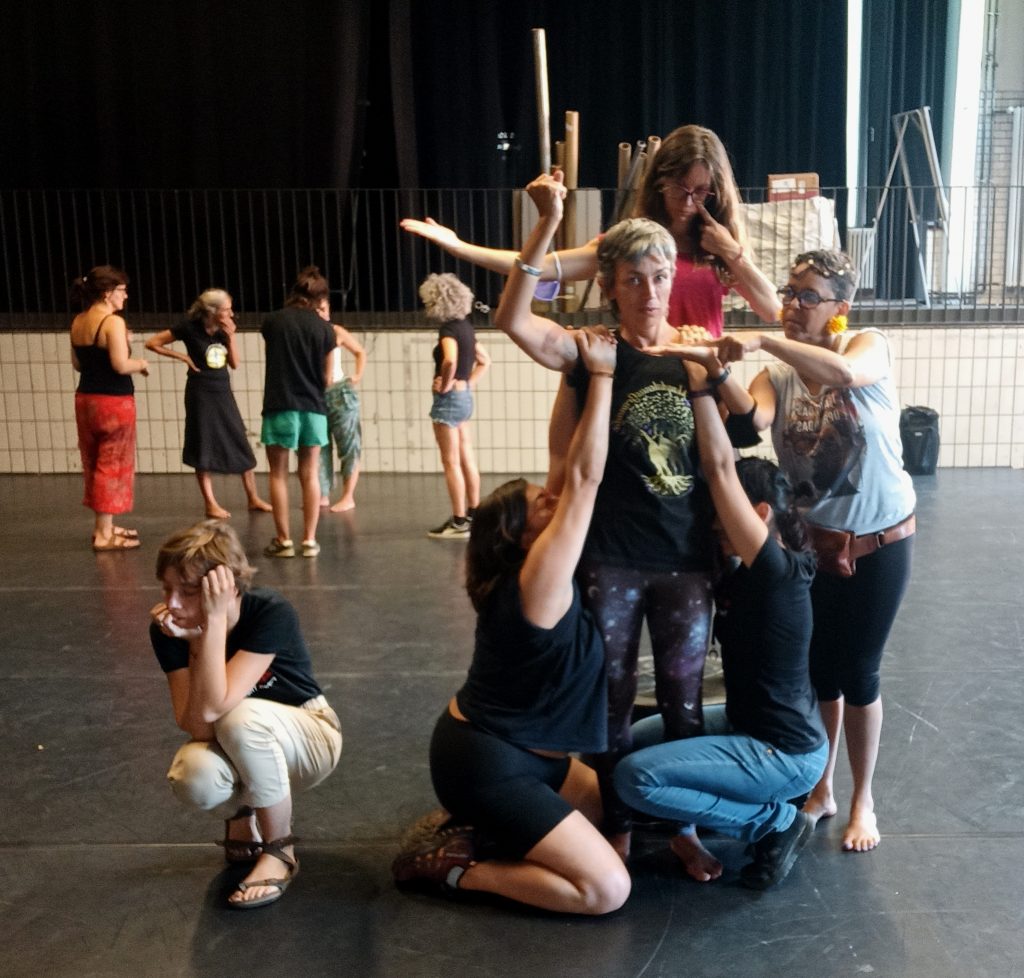
On September 1st., we had the privilege of experiencing a session of Feminist Legislative Theatre, led by Bárbara Santos. This event, inspired by the principles of Teatro de las Oprimidas, was the closure of a 4 days workshop on the technique.
Legislative Theatre was developed during the time Boal was a city councilor in Rio de Janeiro. It was designed to involve citizens directly in the legislative process, allowing them to propose and debate laws that affect their lives. Bárbara Santos, who played a crucial role in the development of Legislative Theatre, continues to evolve this approach, incorporating feminist, anti-racist, and decolonial perspectives to address contemporary social issues. The Feminist Legislative Theatre session introduces a new approach to the method giving space for a collective and horizontal dialog.
The participants at the workshop presented a forum theatre play. The topic was focused on the pressing issue of media, specifically tackling the challenges posed by media addiction, the impact of misinformation on society and how media can shape ideas and ideals.
At the beginning of the event, each person received three colour cards for use during the voting: Green for approval, Red for rejection and Yellow to abstain. After the play, the audience engaged in a dynamic and participatory process, where they not only reflected on the dangers of fake news but also brainstormed practical solutions to combat its spread and mitigate its effects. The discussions were both enlightening and empowering, as they explored various angles of the media landscape and its influence on public perception and behavior. After the discussion the audience members shared their proposals and vote using the cards according to their views.
One of the outcomes of this session was the proposal to introduce Critical Media Education in schools. The audience said that educating both teachers and students on how to critically analyze media content could be a key strategy in countering the spread of misinformation.
Another significant proposal was the call for greater transparency in media funding. The spect-activist suggested that a law should be enacted requiring all media outlets to disclose their funding sources and affiliations. This measure would help the public identify potential biases and conflicts of interest, enabling them to make more informed decisions about the media they consume.
The session also addressed the responsibility of technology companies in curbing the spread of fake news. There was a strong consensus that these companies must be held accountable for the content shared on their platforms. Proposals included implementing stricter regulations on the dissemination of misinformation and creating more robust systems for flagging and removing false content.
However, the idea that resonated most with the public was the importance of promoting real-life connections between people. In a world where digital interaction often replaces face-to-face communication, creating spaces for genuine human connection was seen as essential in combating the isolation that can make individuals more susceptible to misinformation. The audience suggested organizing community events, public forums, and other initiatives that encourage people to come together, share experiences, and engage in meaningful dialogue.
As the session concluded, several questions remained at the forefront of our minds: How can we ensure that the proposals discussed are transformed into actionable policies? What role should the public play in holding media and tech companies accountable? How can we sustain the momentum created by this session and continue to address the ever-evolving challenges of media regulation?
This session of Feminist Legislative Theatre was a powerful reminder of the role that art can play in shaping society: it’s a participatory and democratic methodology that encourages continuous involvement from the community. It empowers people to not only voice their concerns but also to take an active role in shaping the policies that govern their lives. By engaging in this process, the public become more than just spectators—they become agents of change. In a continuous process, the proposals generated during this sessions can have the potential to influence future legislation and drive positive change, proving once again that theatre is not just a reflection of reality—it’s a catalyst for transformation.
We look forward to continuing this important work and invite all those interested in using theatre as a tool for social justice to join us in future sessions.
The Feminist Legislative Theatre session, led by Bárbara Santos, is an innovative approach rooted in the Theatre of the Oppressed (TO), a method developed by Augusto Boal. This methodology emphasizes the importance of theatre not only as a medium for reflection but as a catalyst for action. The Legislative Theatre, a technique of TO, was developed during Boal’s tenure as a representative in the Rio de Janeiro City Council from 1993 to 1996, responding to an urgent need for civic engagement and legislative impact.
Bárbara Santos, who served as the head of Boal’s office and worked closely with various community groups, played a key role in the creation and structuring of Legislative Theatre. Through Forum Theatre productions, community issues were brought to the forefront, providing a platform for the public to engage in discussions and draft legislative proposals. These sessions became essential exercises in exploring collective solutions to societal challenges, with the real-life experiences of theatre group members serving as the foundation for the performances
Since 2016, Bárbara Santos, in collaboration with the Ma-g-dalena International Network of Teatro de las Oprimidas, has developed a feminist, anti-racist, and decolonial approach to Legislative Theatre. This practice emphasizes the decentralization of discussions, promoting a more horizontal relationship between experts and participants, and actively involving associations and social movements to ensure committed engagement and follow-up actions. In 2019, Santos further refined this approach into a workshop model aimed at spreading this practice among Ma-g-dalena Network practitioners.
This model encourages participants to collaboratively identify themes and struggles, creating Forum Theatre plays that resonate with their collective experiences. The Legislative Sessions serve as a space to deepen discussions, analyze the social issues presented, and collectively draft proposals for concrete, sustained action.
We invite you to participate in this unique session, where theatre becomes a powerful tool for legislative and social transformation.
Event Details:
Date: Sunday September 1st.
Time: 5 PM – 7 PM
Location: KURINGA Berlin (Grüntaler Str. 35, 13359 Berlin)
A participatory theater play on the theme of water and our responsibility as humanity (or at least as part of it).
The artistic productions of Bárbara Santos and Till Baumann are the result of research processes into the aesthetics of the oppressed, based on sound/rhythm, image/movement, and word/text, which promote the discovery of creative potentials and the development of an autonomous and critical view of society. The artistic productions aim to connect aesthetic research within a contextual approach, collective learning, and concrete and continuous social actions.
KURINGA Forum Theater addresses issues that challenge the lives of different social groups to promote an active and horizontal dialogue within society. The KURINGA Forum sessions aim to avoid individualistic perspectives and encourage the audience to come together and experience collective strategies for overcoming the oppressions depicted on stage, taking into account the real social position of each individual in life (gender, social class, profession, etc.).
The Aesthetics of the Oppressed is a series of activities aimed at dismantling the strategies of the system of oppression, which influences and convinces oppressed men and women that they are incapable of creating, producing, or deciding, and that they should therefore be content with consumption. The Aesthetics of the Oppressed is an exercise in freedom that stimulates the creative and critical production of culture and knowledge.
This performance will be held in collaboration with Spore Initiative, which facilitates cultural projects at the intersection of climate justice, ecological regeneration, and education, in dialogue with earth protectors in the Global South and the Global North. The Spore House in Berlin serves as a platform for exchange, dialogue, and mutual learning. At the core of their work is the weaving of dialogues and the nurturing of common grounds that exist between communities, organizations, and people who may be geographically or culturally far from one another but are linked through practices of care for the earth.
Dieses Projekt beleuchtet Fragen der Zugehörigkeit, Identität und die Komplexität der Integration durch Klang. In einer schönen Melodie verbessern unterschiedliche Töne und Rhythmen die Musik. Wenn sich Rhythmen vermischen und neue entstehen, wird die Musik bereichert. In der Gesellschaft führen unterschiedliche Identitäten oft zu Problemen: Zweifel, Hass, Angst… Wie kann unter diesen Umständen eine Symphonie gespielt werden, wenn die Identität nur in Verbindung mit anderen, nicht allein, festgelegt wird? Wie kann man sich in eine neue Gesellschaft integrieren, ohne sich zu desintegrieren? Ist Integration nur Papiere, Pässe, Wohnungen und Jobs? Oder kann man all das haben und sich dennoch nicht integriert fühlen?
Madalena-Berlin ist eine feministische Gruppe des Theaters der Unterdrückten. Teil von KURINGA (Berlin). Unter der kreativen Leitung von Bárbara Santos nutzen sie das Forumtheater, um öffentliche Debatten anzustoßen, Ungerechtigkeiten zu identifizieren und das Publikum einzuladen, kollektive Strategien für Veränderungen zu suchen. Im Forumtheater, einer interaktiven Form des Theaters, stellt das Stück eine Frage an das Publikum und lädt sie ein, die auf der Bühne dargestellte Situation zu transformieren. Madalena-Berlin ist Teil des Ma(g)dalena Internationalen Netzwerks, das aus feministischen Theatergruppen aus Lateinamerika, Europa, Afrika und Asien besteht.
Integration-DES-Integration
Exploring themes of identity, this project exposes the questions of belonging and the complexities of integration through sounds. In a beautiful melody, distinct tones and rhythms enhance the music. When rhythms blend and create new ones, the music improves. In society, the more different we are, the greater the problems: doubt, hate, fear… How can a symphony be performed under these circumstances if identity is only established in connection with others – not alone? How can one integrate into a new society without disintegrating ? Is integration just papers, passports, flats and jobs? Or can you have all of that, but still not feel integrated?
Madalena-Berlin is a feminist Theatre of the Oppressed group, part of KURINGA (Berlin). Under the creative direction of Bárbara Santos, they use Forum Theatre to stimulate public debates, identify injustices, and invite the audience to seek collective strategies for change. In Forum Theatre, an interactive form of theatre, the play poses a question to the audience, inviting them to transform the situation depicted on stage. Madalena-Berlin is part of the Ma(g)dalena International Network, composed of feminist theatre groups from Latin America, Europe, Africa, and Asia.
The book ‘s primary objective is to reframe perceptions of oppression and the associated responsibility to initiate change, all while avoiding the pitfalls of individualizing the issue or assigning blame to the people who contend with it. Alongside a comprehensive breakdown of the repertoire of original exercises, games, and techniques, as well as a series of adaptations rooted in the Theatre of the Oppressed method systematized by Augusto Boal, this book provides practical demonstrations of the method’s applicability. It draws upon the real-world experiences of various theater groups spanning different regions of the world to illustrate its effectiveness and its nuanced adaptation to local social systems.
This is a unique opportunity to discover the creative process of Bárbara Santos as detailed in her book. What challenges did she face exploring the portrayal of oppressions intertwined with gender, race, and class from a structural standpoint ? What does “Teatro de las Oprimidas” mean? And, Ma(g)galena International Network?
Where: Studio 14 – UferStudios ( Badstr. 41, Wedding)
When: 21 August 2024, 7pm (with a public exhibition)
Language: Book presentation – English
The book was originally released in Portuguese in 2019, translated into Spanish in 2020, and finally translated into English in 2023.
To acquire a copy of the book, interested readers can reach out to KURINGA directly for purchase options and further information: kuringa@kuringa.org
How do we move creating an image and how are we moved by the created image?
In this two afternoon’s workshop we, Bárbara Santos and Anaïs Héraud, propose a performative experience to produce portraits. A process of painting with a self-reflection using a repertoire of original exercises, games, and theatre techniques, employing feminist aesthetics from an anti-racist, decolonial, and community perspective. In this workshop the act of painting, drawing and building images will be developed from and through the encounter between personal and collective stories. It will result in a collective exhibition that will be shown at the UferStudio and accompagnies by a presentation of Bárbara Santos new book: “Teatro de las Oprimidas – Feminist Aesthetics for Political Poetics”. The workshop is open to everyone and doesn’t require any artistic knowledge or experience. The work will be mainly practically: body work, draw and paint.
Facilitators:
Anaïs Héraud is an artist and member of the Ma-g-dalena International Network:
“A year ago, Bárbara Santos asked me to produce an image to the cover of her book. My idea was incorporate her proposal of feminist aesthetics in a portrait. The painting happened in a performative process expressing the encounter between the writer and her painter. This become an inspiration to this workshop.”
Bárbara Santos is artistic director of the KURINGA theatre space in Berlin and founder of the Ma-g-dalena International Network, made up of theater groups and artist-activists from Latin America, Africa, and Europe. “The process of producing the portrait for the cover of my book became a dynamic artistic experience, which included meetings in Cafés, ateliers and theatre space. This workshop is kind of result of that.”
Where: UferStudios
When: 20 and 21 August 2024
Workshop: 20th, 5pm-9pm and 21st, 5pm-7pm
Public exhibition: 21st, 7pm-9pm (with a book presentation.)
Language: Workshop – English and/or German (but talking is not the main focus).
Book presentation – English
Contribution : 50€ + 5 € material
Registration : qualification@kuringa.org
Please contact us with any special needs and bring clothes in which you can move and paint.
19 August , 19.30 @UferStudios , Studio 14 ( Badstr. 41, Wedding )
Physical Theatre-Stück mit Volksliedern und Tänzen verschiedener Nationen.
Was bleibt, wenn nur noch Asche bleibt? Auf der Suche nach der Zukunft lohnt ein Blick zurück auf das, was war. Welche vergessenen und marginalisierten Lieder, Tänze, Rituale können eine Erzählung darüber schaffen, was uns als Menschen ausmacht? Auf der Bühne entsteht das Bild einer kleinen, globalen Dorfgemeinschaft, in deren Leben das Publikum eingeladen wird. So vereinen sich Fragmente traditioneller Lieder & Choreographien mit physischem Theater, Puppen- und Maskenspiel sowie Livemusik in Bandbesetzung.
Physical Theatre-production with folk songs and dances from different nations.
What remains, when only ashes remain? In search for the future, it is worth taking a look back to what has been. Which forgotten and marginalised songs, dances, rituals can create a narrative about what makes us human?
On stage, the image of a small, global village community emerges, into whose life the audience is invited. Fragments of traditional songs & choreographies with are merged with physical theatre, puppet and mask play as well as live music from the antagon band.
How do we unravel the voices that colonize our minds, limiting and influencing our own narratives from within?
This question lies at the heart of our interactive forum theater piece, the product of the workshop “The Rainbow of Desire from a Feminist Perspective” led by Bárbara Santos.
Through a powerful performance and audience-engaged discussion, we will explore the deeply ingrained societal constructs that shape our identities and perspectives.
Together, we will challenge these internalized limitations and work towards a collective unlearning and reimagining of our stories.
Don’t miss this unique opportunity to engage, reflect, and transform!
🗓️ 26 May 🕠 17 h 📍KURINGA Grüntaler Straße 35 , 13359